
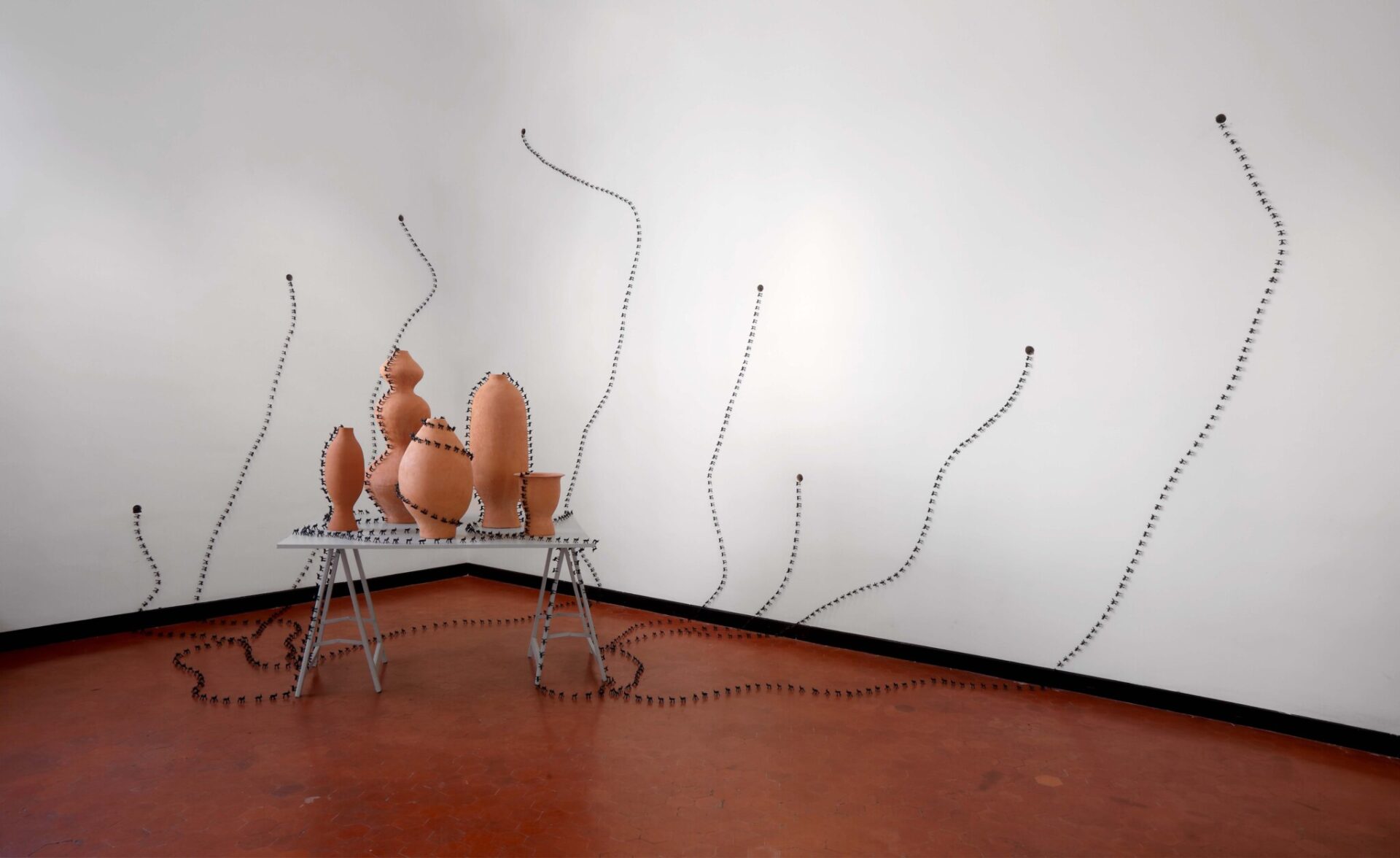
Bagarre, installation view, Studio SALES di Norberto Ruggeri, 2023
Davide Monaldi is a sculptor, and his material of choice is ceramics. It is good to be able to write this: it is a radical choice for an artist of the latest generation; many of his colleagues prefer to move on more languages and more materials. His choice is certainly intriguing and appreciable, because it allows him to investigate with greater freedom and concentration what are the pivotal elements of any artistic work, namely the formal aspects, which are always inextricably connected to the thematic aspects.
His works are a realistic, joyful and ironic representation of the reality that surrounds him. This reality is declined essentially in two ways: the first consists of the reproduction of mundane objects or elements of our everyday reality, such as wallpaper, keys, coffee pots, intercoms, rubber bands, tennis rackets, which are subjected to the artist’s classic stylization process and sometimes to deformations aimed at accentuating their ironic and gently alienating side. The second outlines instead small scenes of life from which the hint of melancholy present in all the artist’s work emerges more clearly. He has found a distinct stylistic signature Monaldi, a recognizability of his own that is appreciable and refreshing in these times when too often artists seem to want to play hide-and-seek without having a real need to do so. The big eyes of his human and animal characters are his distinctiveness, their large heads, their limbs and elongations of bodies and objects, his handwriting in block letters (of course), the fact that everything looks soft. It is a deliberately synthesized style, in which micro-narrative plays a primary role.
He tries to speak to everyone Monaldi, and he does so through a language that if we were lazy we would call pop; it is actually a style indebted to a folk and artisanal culture, not an industrial one, situated exactly at the point where punk culture meets the world of comics and illustration, abandoning its adolescent charge of destructiveness. His Marche origins make me think of the very simple and minimal atmospheres of Maicol&Mirco, with that magical ability to make something very deep and sometimes heartbreaking stand in a scene made of two lines and three sentences.
For this exhibition, the artist decided to present only sculptures in the form of vases, objects he had already worked on in the past, but on this occasion they become the absolute protagonists of the scene. The choice cannot be accidental. The vase is an element with its own well-defined strength and history,It is one of the most common everyday objects found in every home, and this alone places it in a territory that allows the artist to create a definite channel of communication with the memory and life of anyone, even the uninitiated.
The vase is also one of the oldest and most common artifacts of every human civilization, of all times and places on earth. The vase is a vessel, an element capable of containing not only bulk matter inside, but also decorations, images, stories, and artistic representations on its outer surface. Artist Andreas Angelidakis in one of his videos compares the vases of antiquity to what the Internet is for us today, namely a vehicle through which people learned the customs, traditions, stories, myths, and legends of people far from them in space; and a medium through which artistic styles traveled the world, hybridized, and evolved. There are many artists who still work through the vase object, and the two most famous examples are perhaps Luigi Ontani, with his canopic jars, and the British artist Greyson Perry.
There is something strongly connected to our psyche about vases, which transcends the banal symbolism of the womb. There is something dark within them, from which stories like that of Pandora’s box have probably been generated; have to do with the unfathomability of their space, with the difficulty in most cases of completely seeing the inside, of being able to reach it, to clean it. There is something beyond our control. And in these works by Davide Monaldi, precisely an idea of chaos emerges.
On the outer surfaces of the vases we see real chaotic, if ironic and joyful scenes: human bodies, animals and monsters mingle in a struggle from which no one will prevail, and which seems to evoke the scenes of some of Bosch’s infernal paintings, the battles between Romans and barbarians in classical sculpture, Michelangelo’s sublime Centauromachia; or we see naked bodies intent in an orgy of pleasure, a vermicular cluster that seems to expand with the speed of a contagion, where every limb seems to be a chariot endowed with erogenous potential. Even in the case of the partially unglazed vases from which emerges an orderly, militaristic row of ants ready to invade the entire gallery space, the impression is that of being in front of an object from which an out-of-control energy could spring that could overwhelm us. What will end up inside these jars?
text by Antonio Grulli